
Structured Classes
Immersive field trip experiences For Grades K-8
How to schedule a class
Classes must be requested at least two weeks prior to your visit to ensure staffing is available; however, we recommend registering as early as possible for the best selection of dates and times. There are two ways to register:
Register your school online. You’ll need to have your school’s basic information to fill out the form, as well as:
- The title of the desired class
- Number of students
- Number of school staff and chaperones you intend to bring (please note, Stuhr Museum memberships do not cover field trip fees)
- Possible dates to attend
Go to online REGISTRATION form
OR Call us on the phone at (308) 385-5316 and ask for Emma. You will need to have the same information as listed above to complete your registration.
Parent/Guardian Chaperones
Parent chaperones are not required to attend structured classes; however, if your school chooses to bring chaperones, we require no more than 1 adult per 5 students attend with your class. This ratio does not include any school staff needed for 1:1 student assistance.
In order to provide a safe learning environment for students, Stuhr Museum requires that a list of chaperone names be submitted at least 2 days prior to your visit. Only chaperones listed by the school will be permitted to attend the class with students. Chaperones are charged the same rate as students for the class.
Please note, Stuhr Museum memberships do not cover field trip fees for students or chaperones, and chaperones are not allowed to bring additional children to the class, i.e. younger siblings. If chaperones become a distraction or bring additional children to the class, they may be asked to leave at any time at the discretion of the Museum Educator.
Payment
When you submit your registration, we will ask you how you wish to pay. If you prefer to be invoiced, you will need to provide either a mailing address or e-mail address for the person who should receive your school’s invoices. On the day of your visit, we will collect a final headcount to be used for invoicing.
If you prefer to pay on the day of your class, payment by credit card or check can be accepted. Checks must be made out in the correct amount, as we are not able to refund for missing students on the day of your visit.
Schools can choose to have their parent chaperones pay their own fee the day of class, or those fees can also be added to your invoice.
Please note, Stuhr Museum memberships do not cover class fees for students or chaperones.
Scholarships
Field Trip scholarships help provide tuition support for public schools and eligible students participating in the Structured Class Field Trips at Stuhr Museum. Teachers, administrators, and social workers may apply. Field Trip Scholarships are open to Title I and/or Class C or D public schools. For more information, click here.
Applicants must apply before the following deadlines to be considered for scholarships for each season:
For a class taking place this season: |
Application must be received by: |
| FALL 2026 | August 3, 2026 |
| WINTER 2026 (Winter on the Plains, Rural School) | October 5, 2026 |
| WINTER 2027 (Pioneer Living, Rural School) | January 4, 2027 |
| SPRING 2027 | March 8, 2027 |
1-Hour Classes
9:00-10:00 a.m. • 10:30-11:30 a.m.
12:30-1:30 p.m. • 1:45-2:45 p.m.

My First Trip to the Museum
Available February 1 – March 26, 2027 • $8.00 per Person
Come visit Stuhr Museum and discover what a history museum is all about! Learn how museums care for their artifacts and use them to create the exhibits you see in our galleries. Students will follow a story that guides them through the exhibit space upstairs, with plenty of time for questions from our youngest historians!
The maximum capacity for this class is 1 group of up to 25 students per class time. Maximum 1 adult per 5 students. No charge for school staff.

SPRING ON THE FARM
Available April 5 – May 14, 2027 • $8.00 per Person
On a farm in the 1880s, everyone was expected to help with daily chores, even young children! During this program, your students will learn what farm life was like for children as they visit the barn to meet some animal friends and explore the roles of common farm animals like goats and sheep. At the chicken coop, they’ll see chickens up close and even have the chance to hold a baby chick. Other hands-on activities include pumping water and learning why the farm bell was so important.
The maximum capacity for this class is 2 groups of up to 25 students (50 total) per class time. Maximum 1 adult per 5 students. No charge for school staff.
2-Hour Classes
9:00-11:00 a.m. • 12:30-2:30 p.m.
Other times may be available upon request

Fall ON THE FARM
Available SEPTEMBER 8 – October 23, 2026 • $8.00 per Person
Come to the farm and learn about the daily chores that a farm family on the Nebraska plains in the 19th century would have pitched in to do! Stops include the barn, windmill, chicken coop, granary, and garden, with hands-on activities at each site. A few examples include shelling, grinding, and sifting corn—important steps in preparing ingredients for baking and other uses!
The maximum capacity for this class is 2 groups of up to 25 students (50 total) per class time. Maximum 1 adult per 5 students. No charge for school staff.

Pawnee Children
Available April 5 – May 14, 2027 • $8.00 per Person
This area of Nebraska was originally inhabited by the people of the Pawnee Nation. During your class, you will learn about the daily life of Pawnee Children, including what their houses looked like, what they ate, where they got their food, and how they had fun. Your class will visit the Tipi and Earth Lodge, interacting with artifacts along the way. Students will also have the opportunity to play a Buffalo Uses matching game, construct a WeePee, play Pawnee games, and create a faux squash mat weaving.
The maximum capacity for this class is 2 groups of up to 25 students (50 total) per class time. Maximum 1 adult per 5 students. No charge for school staff.

Winter on the Plains
Available November 2 – December 18, 2026 • $8.00 per Person
Step back in time to experience what winter was like for families living on Nebraska’s plains in the 19th century. Students will visit historic homes and take part in seasonal chores that would have kept families busy during the colder months. Along the way, they’ll also explore the holiday traditions and gifts of the era, gaining insight into how people celebrated in different time periods. Class sites include the 1850s Vieregg Cabin, 1880s Hired Man’s House, 1890s Peter Stuhr House, and 1900s Cleary Farmhouse, with each location offering a unique peek into life during a different decade. Teachers may request a specific site when registering; however, please note that this is one of our most popular classes and spots fill up fast!
The maximum capacity for this class is 4 groups of up to 25 students (100 total) per class time. Maximum 1 adult per 5 students. No charge for school staff.

Community Building
Available September 8 – October 23, 2026 • $8.00 per Person
What makes a productive and successful community? Go back in time and examine the diverse communities of Native Americans, early plains settlers, and booming railroad towns. Students will learn how local government and laws within these communities impact the lives of citizens, and will explore financial considerations such as bartering, trading, marketing of goods, and taxation. Community patterns such as land use, roads, etc., will be studied. Hands-on activities will include mapping towns and communities, role-playing community members, and decision-making as a community. This class encourages critical thinking and collaboration while offering a deeper understanding of how communities form, function, and flourish.
The maximum capacity for this class is 1 group of up to 25 students per class time. Maximum 1 adult per 5 students, please. No charge for school staff.

Transportation
Available April 6 – May 14, 2027 • $8.00 per Person
The history of Nebraska’s communities is closely connected to the history of transportation, particularly the movement of people, goods, and ideas, and how these methods have evolved over time. In this class, students will explore the evolution of transportation and its impact on communities as they try out a Pawnee-style travois and learn about early Native American travel, tour a historic veterinary infirmary and discover the important role of horses, examine historic wagons and compare them to modern vehicles, and explore the caboose and learn how steam engines helped shape Nebraska’s landscape. This engaging experience combines history and science to show how transportation has connected and transformed communities across time.
The maximum capacity for this class is 2 groups of up to 25 students (50 total) per class time. Maximum 1 adult per 5 students. No charge for school staff.

Rural School
Available September 2, 2026 – May 14, 2027 • $8.00 per Person
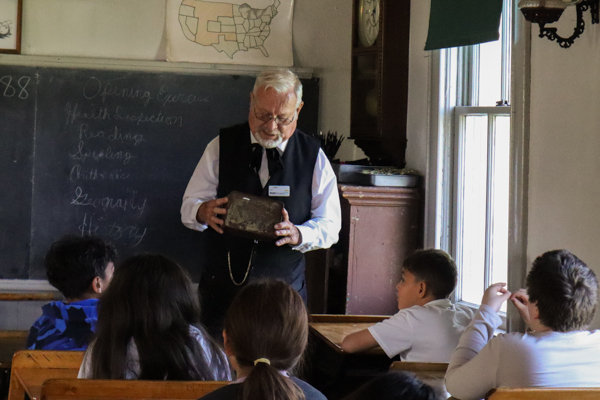
Step into the shoes of a student in 1888! Just like students of the past, your day begins by raising the flag outside the one-room schoolhouse. From there, you’ll enter the cloakroom to learn about daily routines and view a few authentic period items. Once seated at your desk, you’ll hear about the lives of students and teachers on the Nebraska plains in the 1880s. Then it’s time to time travel—your class will be taught in first person, as if it were truly 1888. Students will experience lessons such as reading and arithmetic using reproduction textbooks and chalk slates, penmanship with nib pens and ink, geography with a reproduction 1888 map, history through period paintings and visuals, and a spelling bee! The session ends with the ringing of the school bell, bringing students back to the present, with time for questions and reflection on their journey to the past.
The maximum capacity for this class is 1 group of up to 25 students per class time. Maximum 1 adult per 5 students, please. No charge for school staff.

Great Plains Pawnee
Available September 8 – October 23, 2026 • $8.00 per Person
This area of Nebraska was originally inhabited by the people of the Pawnee Nation. During your class, you will learn about the daily life of Pawnee tribespeople, including their housing arrangements, food sources, culture, and deep ties to the Nebraska prairie. Your class will visit the Tipi and Earth Lodge, interacting with artifacts along the way. Students will also have the opportunity to play a Buffalo Uses matching game, compete in WeePee races, and create a Pawnee-inspired Picture Board.
The maximum capacity for this class is 2 groups of up to 25 students (50 total) per class time. Maximum 1 adult per 5 students, please. No charge for school staff.

Log Cabin Life
Available September 8 – October 23, 2026 • $8.00 per Person
Step back in time and experience what daily life was like for those living on the Nebraska prairie in a log cabin. Students will learn how these cabins were built and hear real stories about the people who once lived in the very cabin they’ll explore. Hands-on activities include making and tasting homemade biscuits and hand-churned butter, washing dishes the old-fashioned way, and twisting and making their own rope to take home. This immersive experience gives students a taste—literally and figuratively—of pioneer life on the plains.
The maximum capacity for this class is 1 group of up to 25 students per class time. Maximum 1 adult per 5 students, please. No charge for school staff.

Business, trades, and town life
Available April 5 – May 14, 2027 • $8.00 per Person
Learn about the businesses, trades, and town life that made up an 1890s Railroad Town. Your class will explore these places by embarking on a town-wide scavenger hunt. Students will utilize prior and acquired knowledge to get from place to place while learning about 1890s life along the way. At each stop, students will read about the history of the building, tour and explore the businesses/trades/sites, and use the new clue to connect them to the next stop. At the end of the field trip, students will also play a unique matching game to test their newfound knowledge, complete with a few challenge questions for the cleverest of groups!
The maximum capacity for this class is 1 group of up to 25 students per class time. Maximum 1 adult per 5 students, please. No charge for school staff.
5-Hour Classes
9:30 a.m. - 2:30 p.m.

Rural School Day
Available September 8, 2026 – May 14, 2027 • $12.00 per Person
This class takes place at the Rural School and expands considerably on the two-hour Rural School class. During a full-day session, you will be able to get a more in-depth experience with each subject taught during a typical 1888 school day. Just like students of the past, your day begins by raising the flag outside the one-room schoolhouse. You’ll then step into the cloakroom to learn about daily routines and examine authentic period items. Once seated at their desks, students will not only hear stories about the lives of teachers and students, but will also experience lessons such as reading and arithmetic using reproduction textbooks and chalk slates, penmanship with nib pens and ink, geography with a reproduction 1888 map, history through period paintings and visuals, and a spelling bee! Students are encouraged to bring a period-appropriate lunch for noon. The day includes two recess periods where your students will play popular period games. Class ends with the final bell, signaling a resumption of modern life, with just enough time for questions and answers.
The maximum capacity for this class is 1 group of up to 25 students per class time. Maximum 1 adult per 5 students, please. No charge for school staff.
+ Period School Lunch Information
+ Downloadable Handwriting Practice Sheet

Overland Trails
Available Tuesdays: September 8 – October 23, 2026 • $15.00 per Person (Lunch included)
Start your school year with an unforgettable hands-on learning experience! In this program, your class will explore the Overland Trails and the motivations behind westward migration. Students will pack their own hand carts and work together to “journey west,” facing trail challenges that require teamwork and communication. Through journal readings and interactive activities, students will gain insight into the hardships pioneers endured. Midday, your group will help prepare and enjoy a meal cooked over an open fire—providing a moment to rest and reflect before continuing on the trail.
Please note: Overland Traisl is available on Tuesdays only during the fall session. Weather-appropriate, layered clothing and closed-toed shoes are required. Long pants are strongly recommended. Please contact us in advance if anyone in your group has food allergies or requires any special accommodations. This helps us prepare to ensure a safe and enjoyable experience for everyone!
The maximum capacity for this class is up to 40 students per class time. Maximum 1 adult per 5 students. School staff will receive a discounted rate of $12.00 (lunch included).

Pioneer Living
Available February 1 – March 26, 2027 • $15.00 per Person (lunch included)
Step back in time and experience the daily life of the pioneers who settled on the Nebraska plains. In this hands-on class, students will explore the challenges and routines that shaped pioneer families and their communities. Through cooking, chores, and storytelling, your class will gain a deeper understanding of how families worked together to survive and thrive in a changing landscape. The day begins with a brief tour of the “out-houses” and their various uses before heading inside to start meal preparations. Together, students will cook stew, corn gems, churn butter, and make corn cob jelly using tools and methods from the past. After sharing a hearty noon meal prepared over a wood cookstove, students will dive into the essential chores that kept pioneer homes running smoothly. They’ll learn about each family member’s responsibilities and how these tasks connected to the larger community. This reflection encourages students to consider the differences and similarities between pioneer life and their own today. Classes take place at one of four historic locations—the 1850s Vieregg Cabin, the 1880s Hired Man’s House, the 1890s Peter Stuhr House, or the 1900s Cleary Farmhouse—each offering a unique glimpse into life during its era.
The maximum capacity for this class is 4 groups of 10-12 students per class time. We request 1-2 adults per group/site. School staff will receive a discounted rate of $12.00 (lunch included).